
Gardeners across the country have long recognized a valuable resource often discarded without a second thought. Wood ash, the powdery residue left behind after burning firewood, has earned the nickname “free gold” among experienced fruit tree cultivators. This mineral-rich substance offers a cost-effective solution for improving soil conditions and boosting tree health. Understanding how to harness its benefits requires knowledge of proper application methods, nutrient content, and potential risks.
Why is wood ash beneficial for fruit trees ?
Natural pH adjustment for optimal growth
Wood ash functions as a powerful alkalizing agent that raises soil pH levels naturally. Most fruit trees thrive in slightly acidic to neutral soil, with pH ranges between 6.0 and 7.0. When soil becomes too acidic, nutrient availability decreases, and tree growth suffers. The calcium carbonate compounds in wood ash neutralize excess acidity, creating ideal conditions for nutrient uptake.
Enhanced fruit production and quality
The mineral composition of wood ash directly impacts fruit development. Trees treated with appropriate amounts of ash often demonstrate:
- Improved fruit size and sweetness
- Stronger resistance to common diseases
- Better winter hardiness
- More vigorous spring growth
- Increased overall yield
These improvements stem from the readily available minerals that support cellular processes essential for fruit formation. The potassium content particularly influences sugar development and fruit quality.
Cost-effective soil improvement
Unlike commercial fertilizers requiring repeated purchases, wood ash represents a renewable resource for homeowners with fireplaces or wood stoves. This economic advantage makes it especially attractive for managing multiple fruit trees or large orchards on limited budgets.
Understanding the benefits sets the foundation for proper implementation in garden settings.
How to correctly apply wood ash in the garden
Timing and frequency recommendations
Application timing significantly affects results. The optimal period for spreading wood ash around fruit trees occurs in late winter or early spring, before new growth begins. This schedule allows minerals to integrate into the soil before trees require nutrients for bud development. Avoid applying ash during active growing seasons, as sudden pH changes can shock root systems.
Proper application techniques
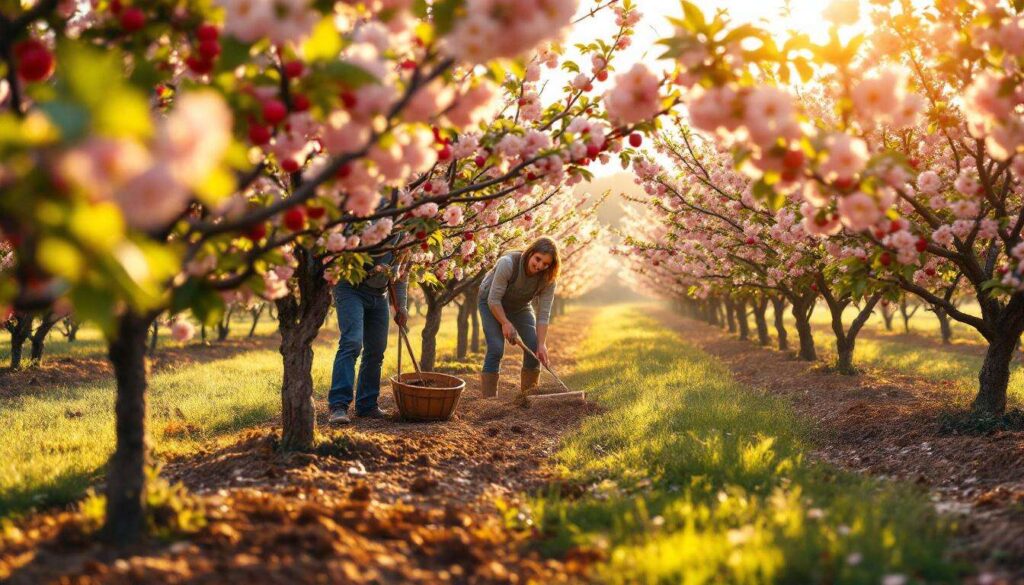
Correct distribution methods prevent nutrient imbalances and root damage. Follow these essential steps:
- Scatter ash evenly around the drip line, not against the trunk
- Keep a 6-inch buffer zone from the base
- Apply a thin layer, approximately 1/4 inch thick
- Work ash gently into the top 2-3 inches of soil
- Water thoroughly after application
Recommended quantities per tree
Dosage depends on tree size and soil conditions. General guidelines include:
| Tree Age | Amount per Application | Maximum Annual Limit |
|---|---|---|
| Young trees (1-3 years) | 1-2 cups | 4 cups |
| Established trees (4-10 years) | 3-5 cups | 10 cups |
| Mature trees (10+ years) | 6-8 cups | 15 cups |
These measurements assume average soil conditions. Always conduct soil tests before application to determine actual needs.
The effectiveness of wood ash depends largely on its mineral composition.
Key nutrients found in wood ash
Potassium: the primary benefit
Potassium comprises the largest nutrient component in wood ash, typically ranging from 3% to 7% by weight. This macronutrient plays crucial roles in:
- Regulating water uptake and retention
- Activating enzyme systems
- Strengthening cell walls
- Improving disease resistance
- Enhancing fruit flavor and color
Unlike synthetic fertilizers, potassium from wood ash releases slowly, providing sustained nutrition throughout the growing season.
Calcium and magnesium content
Wood ash contains significant amounts of calcium, typically between 20% and 30%, which supports cell wall development and prevents disorders like bitter pit in apples. Magnesium, present at 1% to 4%, serves as the central component of chlorophyll molecules, enabling photosynthesis.
Trace minerals for complete nutrition
Beyond major nutrients, wood ash provides essential micronutrients including phosphorus, iron, manganese, boron, and zinc. These elements, though needed in small quantities, prove critical for optimal tree health and fruit production.
However, maximizing benefits requires careful attention to safety considerations.
Precautions to take when using wood ash
Soil testing requirements
Never apply wood ash without first testing soil pH. Trees growing in already alkaline soil (pH above 7.0) can suffer severe nutrient deficiencies if ash raises pH further. Conduct tests annually to monitor changes and adjust application rates accordingly.
Avoiding over-application problems
Excessive wood ash creates multiple problems:
- Nutrient lockout preventing iron and manganese absorption
- Salt accumulation damaging root systems
- Excessive alkalinity killing beneficial soil organisms
- Stunted growth and yellowing foliage
The principle of moderation applies universally to wood ash applications.
Safety measures during handling
Wood ash contains caustic compounds requiring protective measures. Wear gloves and dust masks when spreading ash, as fine particles irritate skin and respiratory passages. Store ash in sealed containers away from moisture to prevent clumping and maintain effectiveness.
Trees and plants to avoid
Acid-loving plants should never receive wood ash treatments. Blueberries, azaleas, rhododendrons, and other ericaceous species require low pH conditions. Even among fruit trees, certain varieties prefer more acidic conditions and respond poorly to ash applications.
The source material significantly influences ash quality and safety.
What type of wood to choose to obtain beneficial ash
Best hardwood options
Hardwoods produce superior ash quality compared to softwoods. Preferred species include:
- Oak: high mineral content, excellent potassium levels
- Maple: balanced nutrient profile
- Ash: ironically named, produces premium quality residue
- Beech: consistent mineral composition
- Birch: good all-purpose option
Woods to avoid completely
Certain materials produce toxic or contaminated ash unsuitable for gardens. Never use ash from:
- Treated or painted lumber containing chemicals
- Plywood or particle board with adhesive resins
- Coal or charcoal briquettes
- Glossy printed materials or cardboard
- Pressure-treated wood containing arsenic or chromium
These materials introduce harmful substances that persist in soil and potentially contaminate fruit.
Importance of complete combustion
Thoroughly burned wood produces the most beneficial ash. Incomplete combustion leaves charcoal pieces and reduces mineral availability. Ensure fires burn hot and completely, leaving only fine gray powder for garden use.
Comparing wood ash to commercial alternatives reveals distinct advantages and limitations.
Comparison between wood ash and other soil amendments
Wood ash versus lime
Both products raise soil pH, but wood ash acts more quickly while providing additional nutrients. Lime offers more predictable pH adjustment and longer-lasting effects. The choice depends on specific soil conditions and nutrient needs.
| Feature | Wood Ash | Agricultural Lime |
|---|---|---|
| pH adjustment speed | Fast (weeks) | Slow (months) |
| Duration of effect | 6-12 months | 2-3 years |
| Potassium content | High (3-7%) | None |
| Cost | Free (if available) | Moderate |
Comparison with commercial fertilizers
Synthetic fertilizers provide precise nutrient ratios and predictable results but lack the trace minerals and organic matter benefits of wood ash. Commercial products work faster but require frequent reapplication and represent ongoing expenses.
Wood ash versus compost
Compost improves soil structure and provides slow-release nutrients without dramatically altering pH. Wood ash offers concentrated minerals but does little for soil texture. The ideal approach combines both amendments, using compost for organic matter and ash for mineral supplementation and pH adjustment.
Wood ash deserves its reputation as valuable garden gold when used appropriately. This free resource provides essential minerals, adjusts soil pH naturally, and improves fruit tree health without recurring costs. Success requires understanding proper application rates, timing, and safety precautions. Soil testing remains crucial for determining actual needs and preventing over-application problems. By selecting clean hardwood sources and following recommended guidelines, gardeners can transform this common byproduct into a powerful tool for cultivating healthy, productive fruit trees.