
Two magnificent trees command attention when they burst into bloom, transforming entire streetscapes and parks into spectacular displays of color. The jacaranda and flame tree both deliver breathtaking seasonal shows that stop pedestrians in their tracks, yet many observers struggle to distinguish between these botanical showstoppers. Understanding the key differences between these species helps gardeners, landscapers, and tree enthusiasts make informed decisions about which specimen best suits their particular environment and aesthetic goals.
Introduction to Jacaranda and Flame Tree
The jacaranda, scientifically known as Jacaranda mimosifolia, originates from South America, particularly Argentina, Bolivia, and Brazil. This deciduous to semi-evergreen tree has spread across subtropical and warm temperate regions worldwide, becoming an iconic feature in cities from Pretoria to Los Angeles. The flame tree, or Delonix regia, also called the royal poinciana or flamboyant, hails from Madagascar and has naturalized throughout tropical and subtropical zones globally.
Geographic distribution and popularity
Both species have achieved remarkable success as ornamental plantings far beyond their native ranges. The jacaranda thrives in Mediterranean climates and areas with mild winters, while the flame tree requires truly frost-free environments to flourish. Their popularity stems from several factors:
- Dramatic flowering displays that create memorable seasonal landmarks
- Relatively fast growth rates compared to other ornamental trees
- Broad canopies that provide substantial shade
- Cultural significance in adopted regions
These characteristics have established both trees as municipal favorites for street plantings and park landscapes. Their differences become more apparent when examining their botanical structures and growing requirements.
Botanical differences between Jacaranda and Flame Tree
The taxonomic classification reveals fundamental distinctions between these two species. Jacaranda belongs to the Bignoniaceae family, which includes trumpet vines and catalpa trees, while the flame tree sits within the Fabaceae family, the legume group that encompasses beans, acacias, and wisteria.
Family characteristics and implications
This family difference manifests in several observable ways. As a legume, the flame tree produces distinctive long, woody seed pods that can reach 24 inches in length and persist on branches for months after flowering. These flat, dark brown pods contain numerous seeds and often remain attached through the following flowering season. The jacaranda produces much smaller, rounded seed capsules approximately 2 inches in diameter that split open to release flat, winged seeds.
| Feature | Jacaranda | Flame Tree |
|---|---|---|
| Family | Bignoniaceae | Fabaceae |
| Seed pods | 2-inch round capsules | 24-inch flat pods |
| Root system | Moderately aggressive | Shallow and spreading |
| Growth rate | Moderate to fast | Fast |
Root system considerations
The flame tree develops a particularly shallow and extensive root system that can disrupt paving, foundations, and underground utilities. This characteristic makes placement critical in urban settings. Jacaranda roots, while still requiring consideration, typically cause fewer infrastructure problems. These structural differences influence not only planting decisions but also long-term maintenance requirements and associated costs.
Understanding these botanical foundations helps explain the visible characteristics that most readily distinguish the two species.
Visual characteristics: flowers and foliage
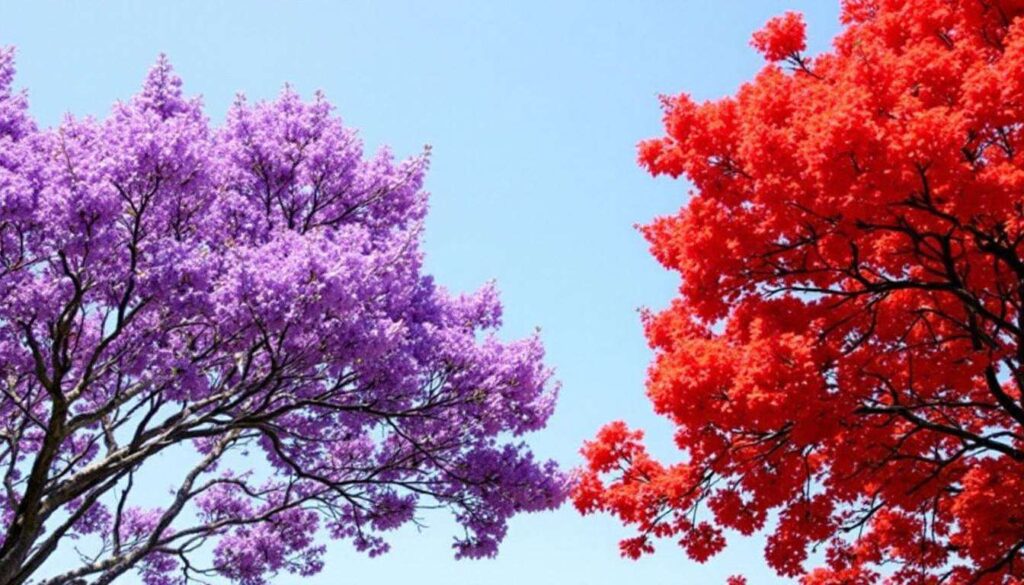
The most striking difference appears in the flower color. Jacarandas produce masses of lavender-blue to purple blooms, while flame trees live up to their name with brilliant scarlet-red to orange-red flowers. Both species bloom profusely, often covering the entire canopy and creating a stunning visual impact that can last several weeks.
Flower structure and timing
Jacaranda flowers form tubular, trumpet-shaped blooms approximately 2 inches long, clustered in large panicles at branch tips. The flame tree produces larger individual flowers, measuring 3 to 4 inches across, with five distinct petals that create a more open, spreading form. One petal typically displays contrasting yellow and white markings, adding visual complexity to the display.
Bloom timing varies by climate but generally follows these patterns:
- Jacaranda: late spring to early summer in most regions
- Flame tree: late spring to summer in tropical areas, sometimes extending into fall
- Both species may bloom twice annually in ideal conditions
- Flowering intensity increases as trees mature
Foliage characteristics
The leaf structure provides another reliable identification method. Jacarandas display finely divided, fernlike foliage with bipinnate compound leaves that can contain hundreds of tiny leaflets, creating a delicate, feathery appearance. This fine texture gives the tree an airy quality even when not in bloom. The flame tree features larger, bipinnate leaves with fewer, more substantial leaflets, creating a coarser texture overall. Each flame tree leaf typically contains 10 to 25 pairs of pinnae, with each pinna bearing 10 to 30 leaflets.
| Characteristic | Jacaranda | Flame Tree |
|---|---|---|
| Flower color | Lavender-blue to purple | Scarlet-red to orange-red |
| Flower size | 2 inches | 3-4 inches |
| Leaf texture | Fine, fernlike | Coarser, substantial |
| Canopy shape | Rounded to spreading | Wide, umbrella-like |
These visual distinctions become particularly important when considering where and how to cultivate these trees.
Environment and growth conditions
Temperature tolerance represents the most critical environmental difference. Jacarandas withstand brief periods of light frost and can survive in USDA zones 9b through 11, while flame trees require completely frost-free conditions and thrive only in zones 10 through 12. This fundamental difference dramatically affects where each species can successfully establish.
Climate requirements
Jacarandas prefer Mediterranean climates with distinct wet and dry seasons, performing best where winters remain mild but provide enough chill to trigger spectacular spring blooming. They tolerate drought once established but appreciate occasional deep watering during extended dry periods. Flame trees demand tropical to subtropical conditions with warm temperatures year-round, suffering damage or death if exposed to temperatures below 40°F for extended periods.
Soil and water needs
Both species adapt to various soil types but perform optimally under specific conditions:
- Jacaranda: well-drained soils, pH 5.5-7.5, moderate water once established
- Flame tree: tolerates poor soils including sandy and alkaline conditions, drought-tolerant after establishment
- Both: require good drainage to prevent root rot
- Neither tolerates waterlogged conditions
The flame tree demonstrates remarkable salt tolerance, making it suitable for coastal plantings where salt spray and sandy soils challenge many species. Jacarandas show moderate salt tolerance but perform better in inland locations protected from direct ocean exposure.
Space requirements
Mature size considerations affect placement decisions significantly. Jacarandas typically reach 25 to 50 feet tall with spreads of 15 to 30 feet, while flame trees commonly achieve 30 to 40 feet in height with canopy spreads exceeding 40 to 60 feet. The flame tree’s wide, spreading form requires substantial space, making it less suitable for narrow streets or small yards. These practical considerations connect directly to how people use and value these trees.
Uses and symbolism of both trees
Both species carry significant cultural meaning in their adopted homes. Jacarandas signal exam season at universities across Australia and South Africa, their purple blooms coinciding with end-of-year academic stress. In Pretoria, South Africa, jacarandas have become so synonymous with the city that it earned the nickname “Jacaranda City,” despite the trees’ non-native status.
Landscape applications
Professional landscapers and municipal planners select these trees for specific purposes:
- Street tree plantings where dramatic seasonal displays enhance civic pride
- Park specimens providing shade and visual focal points
- Residential shade trees in appropriate climate zones
- Botanical garden collections showcasing tropical and subtropical flora
The flame tree serves as the official tree of the Canary Islands and appears on the coat of arms of several municipalities. Its spectacular blooms make it a favorite subject for photographers and artists throughout the tropics.
Practical considerations
Beyond aesthetics, both trees provide functional benefits. Their broad canopies create substantial cooling effects in urban heat islands, reducing ambient temperatures and energy costs for nearby buildings. However, the seasonal leaf drop and flower litter require maintenance consideration. Jacaranda flowers create purple carpets beneath trees that some find charming and others consider messy. Flame tree flowers and large seed pods generate even more substantial cleanup requirements.
These practical factors should inform selection decisions for specific situations and preferences.
Tips for choosing between Jacaranda and Flame Tree
Climate represents the primary selection criterion. If your region experiences any frost, the jacaranda becomes the only viable option between these two species. For truly tropical locations, both remain possibilities, making other factors decisive.
Site evaluation checklist
Assess your specific location using these criteria:
- Available space: flame trees need significantly more horizontal room
- Proximity to structures: consider root systems and potential damage
- Maintenance capacity: evaluate tolerance for seasonal debris
- Aesthetic preference: determine whether blue-purple or red-orange flowers suit your vision
- Existing landscape: consider color coordination with other plantings
Long-term considerations
Think beyond initial planting to future scenarios. Jacarandas typically live 50 to 75 years with proper care, while flame trees often reach similar ages in ideal conditions. Both require minimal pruning once established, though structural pruning during youth helps develop strong branch architecture. The flame tree’s shallow roots and heavy canopy make it more susceptible to wind damage, potentially creating liability concerns in hurricane-prone regions.
| Decision Factor | Choose Jacaranda If | Choose Flame Tree If |
|---|---|---|
| Climate | Mild winters possible | Completely frost-free |
| Space | Moderate area available | Large area available |
| Color preference | Blue-purple appeals | Red-orange preferred |
| Coastal location | Protected from salt | Direct salt exposure |
Consulting with local arborists or extension services provides region-specific guidance that accounts for microclimates and local growing conditions not apparent from general guidelines.
These two spectacular flowering trees offer distinct advantages depending on climate, space, and aesthetic preferences. The jacaranda’s purple blooms and finer texture suit Mediterranean and warm temperate zones, while the flame tree’s scarlet display and robust nature thrive in tropical settings. Understanding their botanical differences, visual characteristics, environmental requirements, and practical implications enables informed selection that ensures decades of seasonal beauty. Whether choosing the ethereal blue haze of jacaranda or the fiery brilliance of flame tree, both species deliver transformative landscape impact that justifies their worldwide popularity.